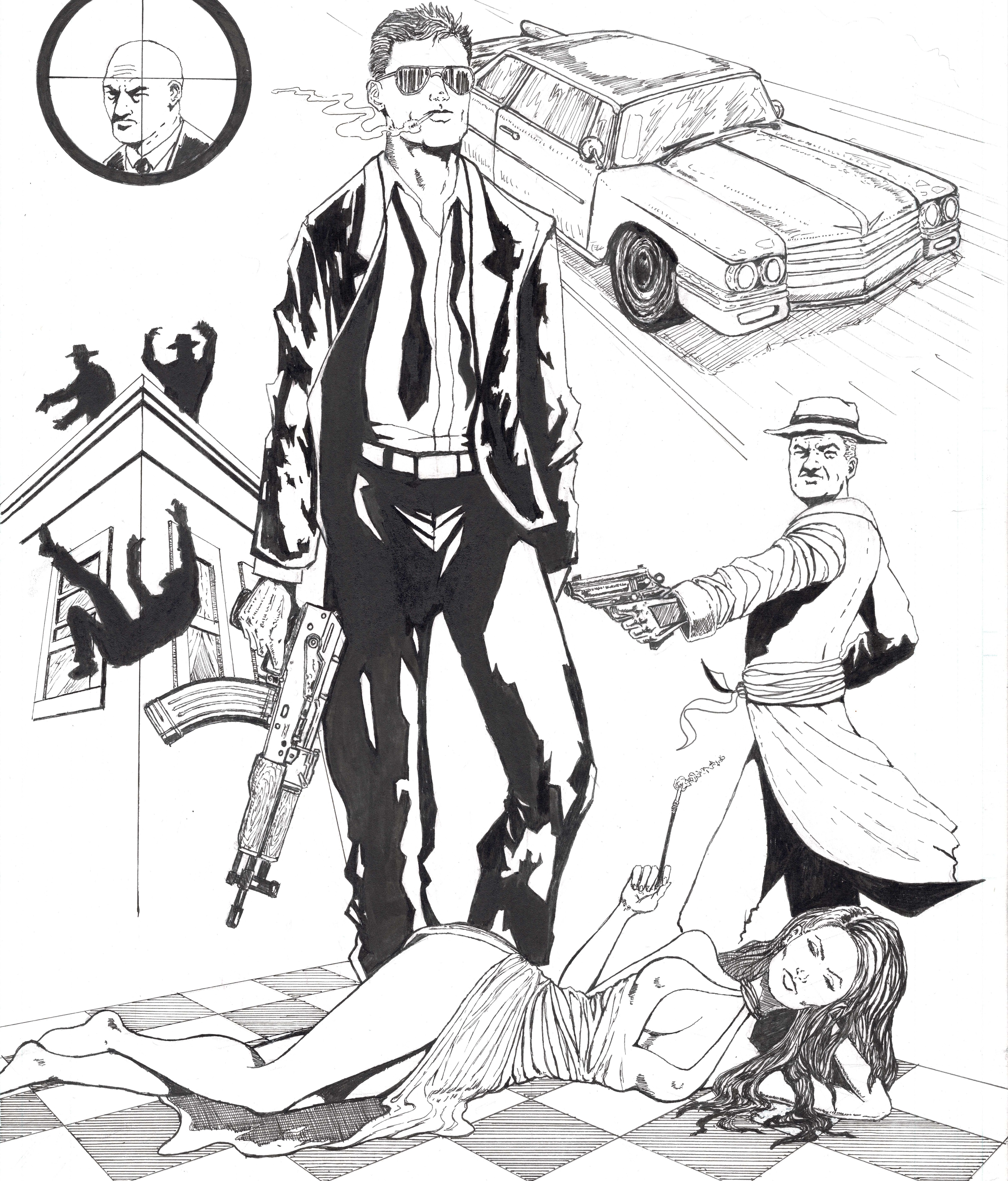
Bang. You just pulled the trigger on your gun. You quickly tuck the weapon under your jacket, take a deep breath, remember to look 360 degrees around you for any irregularities, and make a decision on which one of your 3 departure routes is now the best option. The tension in your mind as you think, “wow I actually did it” isn’t allowed to rise beyond a level of mere curiosity because those thoughts are quickly replaced with “I’ve got to get out of here, and fast.” You purposely move slower than you want because they’ve taught you over and over that the biggest problem you’ll have is not realizing how much you will tend to rush and how your speech rate will almost double. This visible nervousness is the quickest way to be a suspect; the quickest way to end up in a cell somewhere. You didn’t know the target. You just knew who he was, where he was, and how you were going to get the job done. You don’t remember if your hand was shaking or your pulse was racing before the moment of truth but you can’t help but think “the training worked.” You saw him, you followed him nonchalantly, waited until he was alone in the museum hallway like they said he would be, closed the window curtains, attached the silencer to your pistol, and in one smooth motion……walked behind him, raised the gun to his head, pulled the trigger, and kept walking. They taught you headshots at close range, never stop moving, don’t even look to see if the body drops because you just popped them at the base of the skull which means you don’t waste even a second to confirm. You keep moving at any cost but in a smooth, steady manner. You know that no one will react for 5 – 10 seconds which gives you enough time to walk out the hallway, take a left at the stairs, and walk out the east building exit onto market street. You know that despite what you think, the psychologists at the Center have assured you that the crowd will be too interested trying to get to the place they heard the noise from and know what’s going on to even notice you walking smoothly away in the opposite direction. That word again, smooth. 3 days later and your plane will touch down in L.A. and you’ll finally feel a sense of relief, finally rid yourself of the fear of getting caught. You trained for years for something like this, and now you’ve actually done it. You can never talk about it, but now back at the Center, you will know that you are one of the “real” operators who has done an actual mission, not some imposter whose only experience is training scenarios at the shooting house. Time to go home now. Time to sleep for the first time in days. Time to go forward for the rest of your life with a new self-imposed identity: Spy.
The days of the Cold War were interesting ones for spies. The tried and true methods Special Operations Executive (SOE) and Office of Strategic Services (OSS) that served men well throughout the end of World War II were well in existence. However, these men were about to embark on a new change. Instead of relying on guts and savvy to accomplish assassinations and gather information, it became much more effective to leverage the local populace and develop sleeper networks to gather intelligence through a network. Yet, the old school craftsmen of yesteryear could barely fathom such concepts. After all, they had taken down enemies by undercover covert operations, pinpoint yet brutal acts of violence, and personal skills that made them into weapons of their countries. It is their stories, in the passing twilight of their time, that is the stuff of legends. The scenario above was suddenly becoming less and less common and the agencies were changing into a place where analytical brains, not brass-ball guts, made you a valuable asset. But those days are the stuff of spy novels and action movies. Join me as we honor this glorious age of spies through “Smoke, Drink, Spy.”
 Smoke, Drink, Spy.